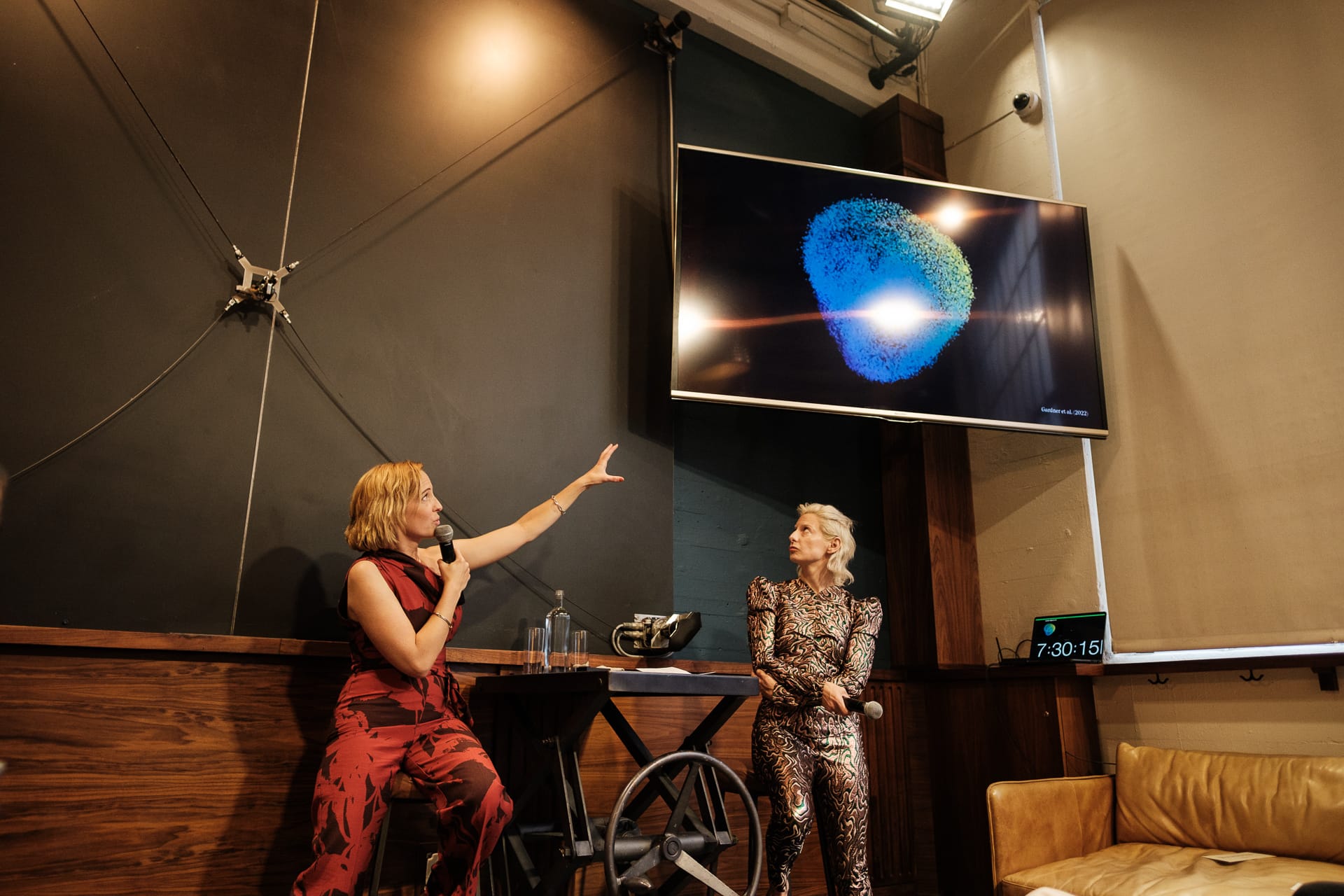
In April 02026, Miolane spoke with Claire Isabel Webb, Director of the Future Humans program at the Berggruen Institute. This is an adapted transcript of Miolane’s remarks and their conversation at The Interval at Long Now, lightly edited for length and clarity.
This piece appears in Pace Layers 02026 – 02027, the third issue of Long Now's annual print journal.
SUBSCRIBE >
We have technology today that allows us to image hundreds of thousands of neurons, sometimes up to 1 million neurons in the living brain. That’s extremely exciting, but it also highlights a key tension in neuroscience right now: technology has outpaced our theoretical understanding. We can watch what is happening in the living brain in almost real time, but we do not know how the firing of these neurons encodes our subjective experience.
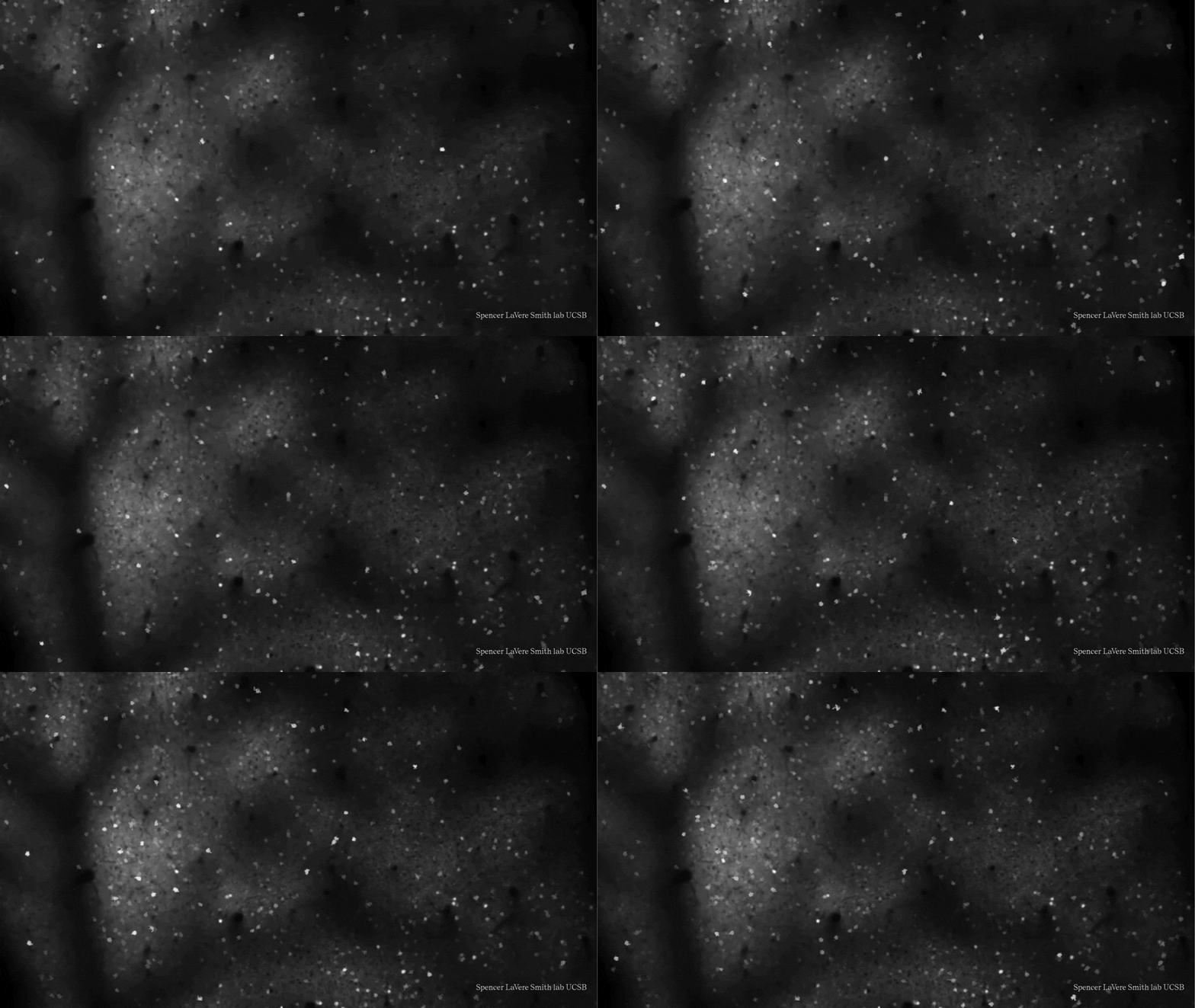
This is a recording from my colleagues at UCSB of the visual cortex of a living mouse. Those flashing lights are firing neurons. If we look at these patterns, at least to me, at first they seem quite disorganized, almost random. Where is the structure?
And yet somehow in this randomness is encoded everything we see, everything we hear, everything we feel, touch, even our decision-making, our capacity for planning and acting and interacting in the world. How is that possible? How can we even begin to make sense of the complexity of this data? What is the right approach? What are the right tools, the right mathematics? This is the question that animates my lab, but it’s a question that has animated neuroscientists for quite some time. Even before we had such incredible recordings, scientists were asking: how does the electrical activity of neurons encode subjective experience?
Because neuroscientists have thought about that for over a century, we’re going to take a step back in time and look at the researcher who discovered the first clue.
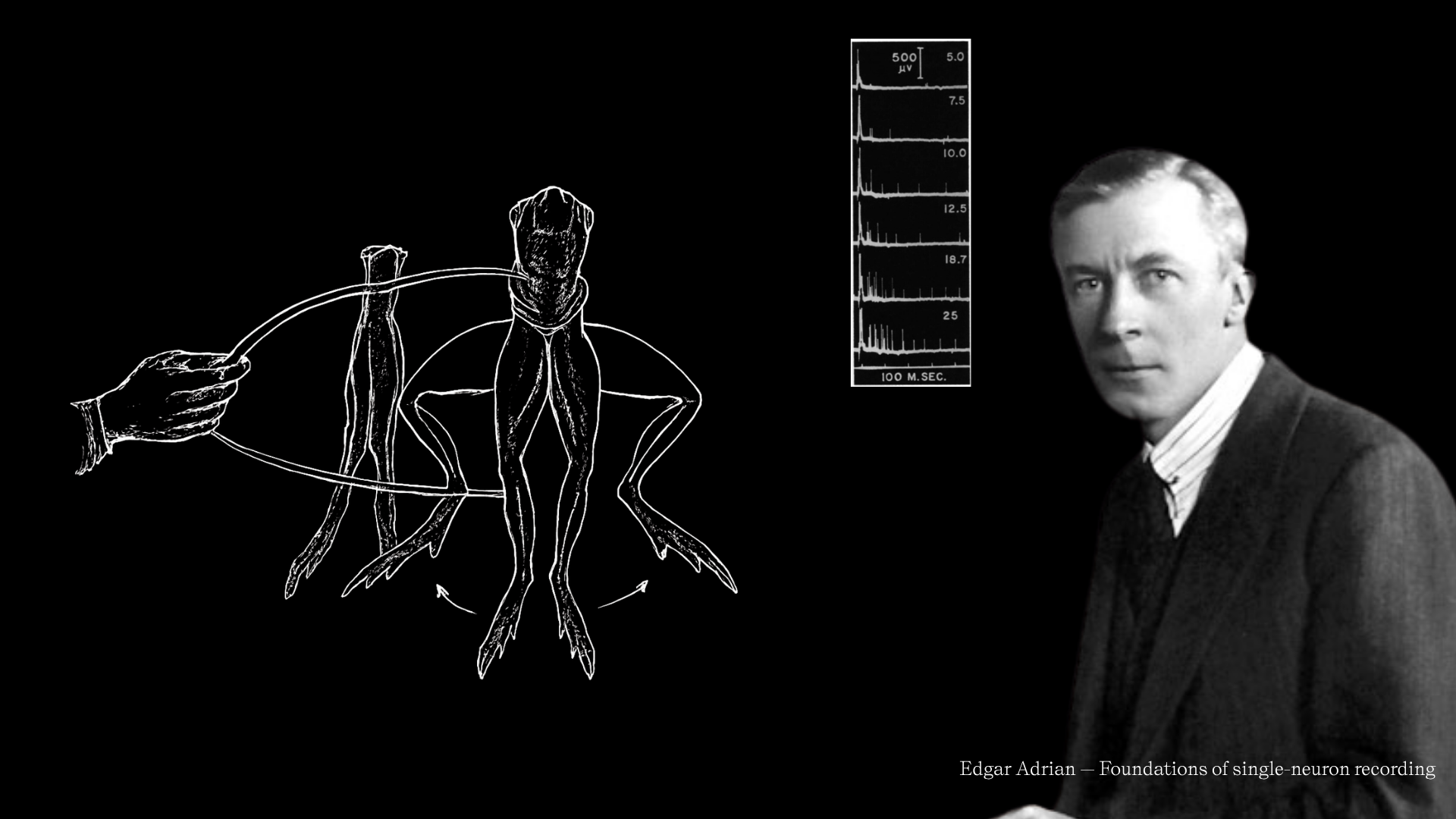
That researcher is Edgar Adrian, and he got the Nobel Prize in 01932 for his discovery. Adrian was interested in how neurons encode our subjective experience, but he was particularly puzzled by one thing: neurons have a binary code. The neuron is either on or off. Either it’s firing or it’s not. The magnitude of the firing, the voltage, is almost always the same.
And that was very puzzling because it seemed completely contradictory with subjective experience. Our experience of the world feels very continuous. You can tell the loudness of a sound, the redness of the red, the intensity of a touch. So how is it possible that a binary code — a neuron that’s either on or off — encodes this continuous subjective experience? Adrian found an answer, and we’re going to go through the experiment he conducted.
He took the leg of a deceased frog. In this leg, there were neurons known to fire when the muscle was being stretched. He recorded from those neurons when putting different weights at the extremity of this muscle, asking: “How will this neuron behave if I put more weight?” 5 grams, 10 grams, 25 grams. What he saw is that the magnitude of the firing didn’t change, but the number of times the neuron was spiking did. At the top of the column is when he was attaching a small weight, and the neuron was firing once. At the bottom, a bigger load, and the neuron was firing 5 to 10 times.
So the firing rate — the number of times per, say, 10 milliseconds — is a continuous variable encoding a continuous experience. That was an extraordinary discovery, and it unleashed a program in neuroscience that lasted over a decade, in which researchers were looking at individual neurons and asking: “What is this neuron coding for?”
A little bit after Adrian, Hubel and Wiesel got the Nobel Prize for discovering a neuron in the visual cortex that fires every time there’s a vertical bar in the visual field. Then other neuroscientists recorded from a part of the brain that encodes navigation or sense of place, and found neurons with an increased firing rate every time the animal is in a specific location. So every time I’m here, I have neurons in my brain that fire to encode the fact that I’m currently right here in this room. These place cells also got the Nobel Prize.
And then other researchers made a peculiar discovery by pushing this logic further. In the visual cortex, they found one neuron that fired every time Jennifer Aniston was mentioned. Yes, the actress. It would fire like crazy every time there was a picture of Jennifer Aniston — didn’t matter the clothing, didn’t matter the haircut, it could be a drawing, it could be the words “Jennifer Aniston.” They called it the Jennifer Aniston neuron.
It’s one of my favorite findings because I think it’s really weird and interesting, but the Jennifer Aniston neuron also highlights the limitations of this research program — what we call the “single neuron doctrine,” because it looks at individual neurons and asks, what is this neuron firing for? There are 80 billion neurons in the human brain. If we want to catalog what each neuron does, we’re going to be here for a very long time. And many neurons aren’t as interpretable: there are neurons that code for many things at once, maybe the color red and also curvy lines. It’s an explosion of possibilities.
These limitations drove my lab and others to move away from the single neuron doctrine and embrace the analysis of population coding. We don’t analyze one neuron at a time but rather ask: what does this group of 1,000 neurons code together? And what my lab is doing in particular is writing a mathematical theory of intelligence. We believe there are mathematical equations that can describe the geometric patterns you find when you look at the collective activity of thousands of neurons, and I’m going to show you how that works.
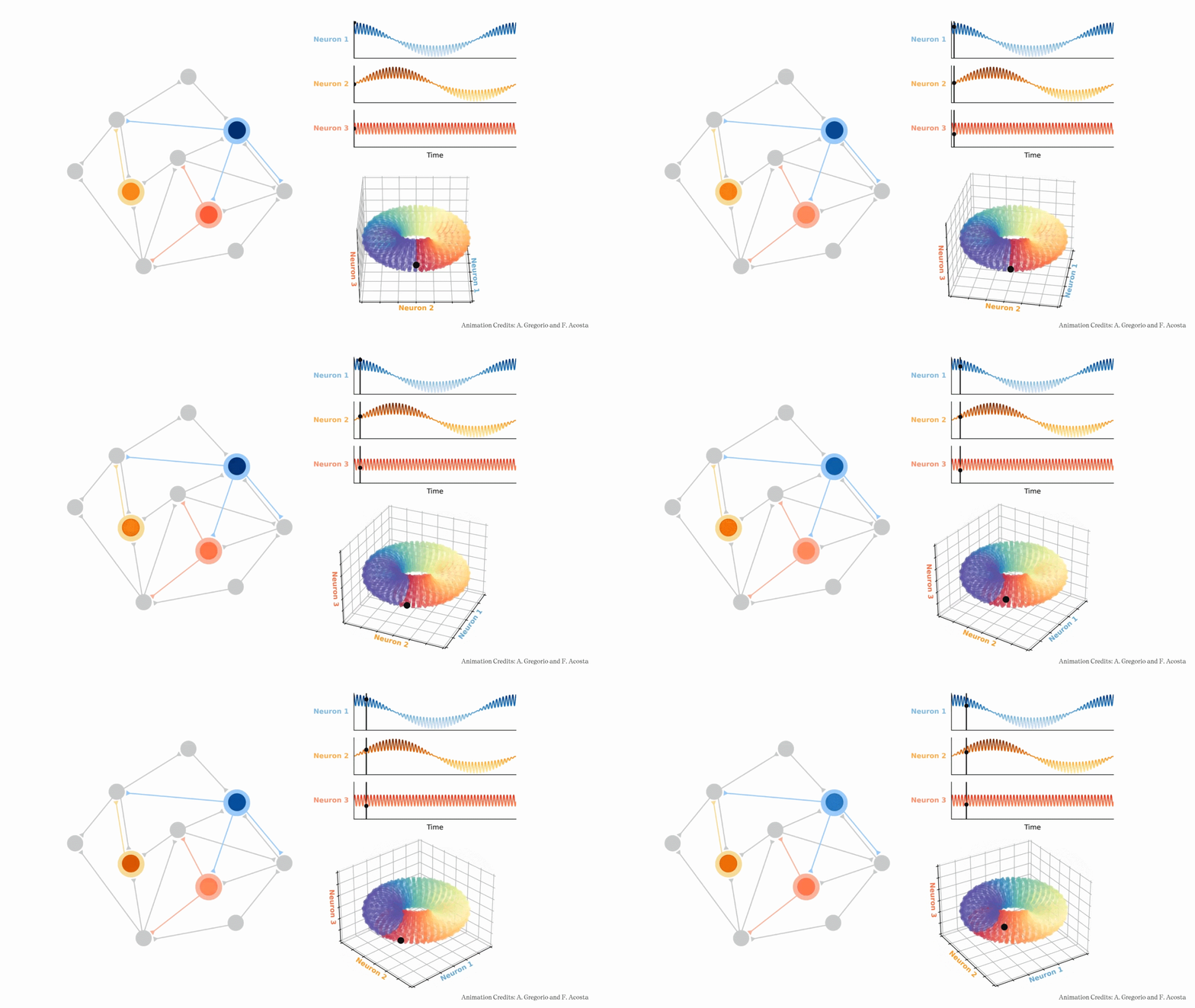
This is a simplified representation of the brain. We have just a few neurons, and we’re going to focus on three: the blue, the red, and the yellow. These neurons are firing, and on the top right, we record their firing rates — neuron one oscillates, neuron two oscillates, same for neuron three.
Now, the conceptual shift — and what our lab is bringing to the table — is a new way of visualizing the same data. We take those three time series and represent them in a 3D space. At a point in time, neuron one has a given firing rate, neuron two has a given firing rate, neuron three has a given firing rate. These are three coordinates we can plot. The X-axis is the firing rate of neuron one, the Y-axis is the firing rate of neuron two, the Z-axis is neuron three.
One point in this space represents the collective activity of the three neurons at a given time. As time unfolds, that point moves through 3D space. And what’s striking is that the geometric pattern it describes is a perfect torus, a doughnut shape. This is just a simulation; it’s not real data. But I’m going to show you real data now.
Record from a brain circuit in a mouse that encodes space — where the mouse thinks it is at a given point in time. Researchers recorded from 150 neurons and plotted their collective activity as a point in 150-dimensional space. On the previous slide, I was showing you three neurons, therefore a 3D space, but researchers record from many more. In that case they recorded from 150, and so the collective activity is one point in 150 dimensions. For us to see, they projected that down to 3D, and this is what they found: a torus. Real data. The electrical activity of 150 neurons organizes itself on a torus.
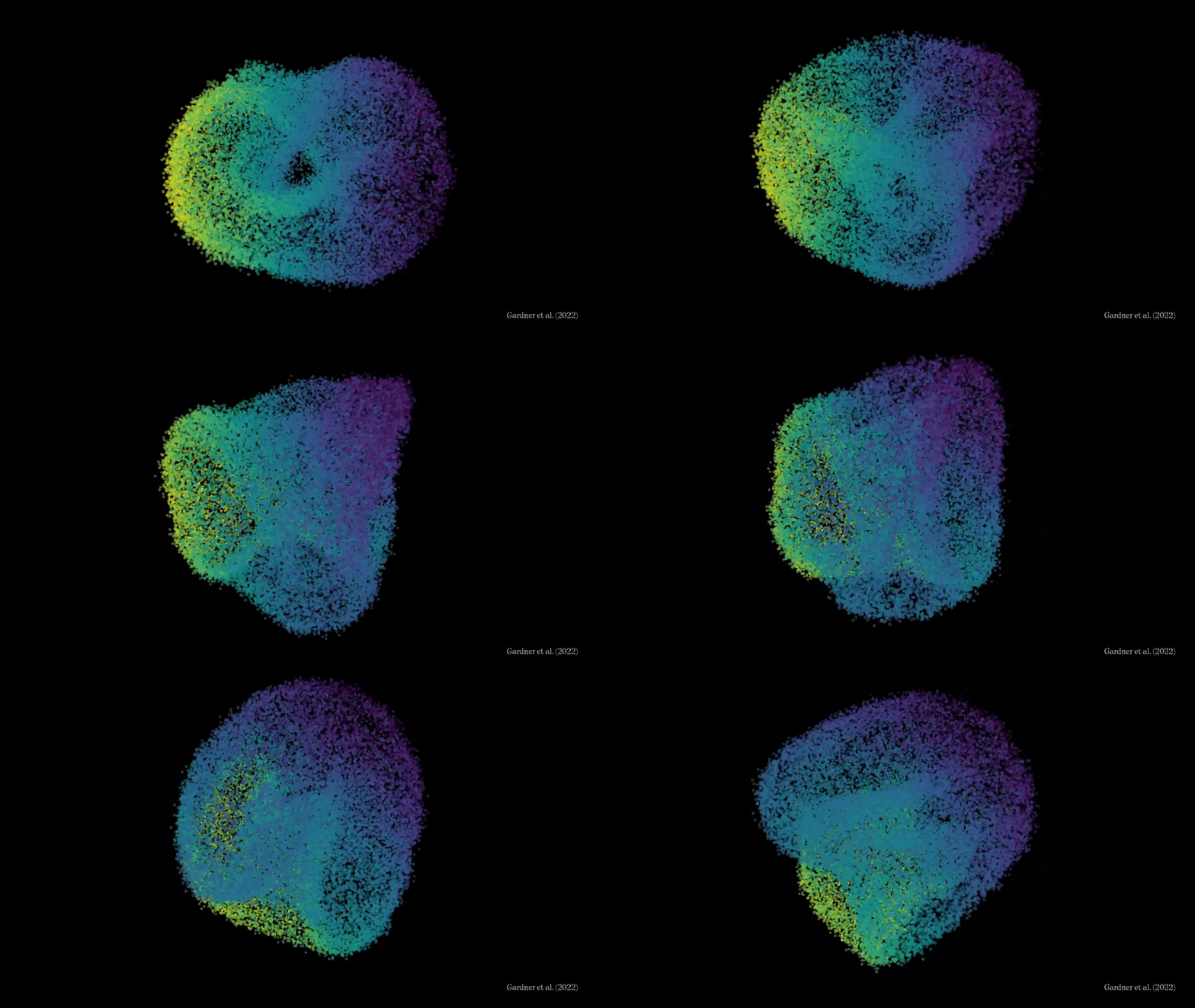
When you think about it, that’s very profound. They recorded from 150 neurons, meaning that point in 150-dimensional space could have gone anywhere, could have explored all 150 dimensions of this crazy high-dimensional space. And yet there are such strong structures that constrain it to live on the two-dimensional surface of a torus. This type of structure is where the work of my lab begins, because we’re not content to just observe the geometry. We want to know why.
I’m a physicist by training, and in physics, Kepler was the first to discover that the trajectories of planets around the sun were elliptical. That was a beautiful and perfect geometric discovery, but it didn’t explain why the trajectories were elliptical. He reported it. So that’s what we’re doing now: we’re reporting that the electrical activity of neurons is a torus. What Newton did is derive laws that explain why the trajectories of planets are elliptical around the sun. That’s a direct consequence of Newton’s laws of motion and theory of gravitation.
That’s what my lab is after: finding the equations that can explain why we see such beautiful and symmetric patterns when we plot the geometry of the electrical activity of neurons. We are building what we call a mathematical theory of intelligence. We believe that there are unifying principles, mathematical equations that can describe how intelligent systems, both brains and machines, operate in the world.

Claire Isabel Webb: Can you talk about biological and artificial systems? You’re working on noticing the mathematical similarities as opposed to trying to build an AI that is exactly like a human mind but made out of a different material. Tell us why you did that and why it’s important.
Nina Miolane: It might seem weird to think we can find unifying principles across biological and artificial intelligence, because the systems have fundamental differences. Biological neural networks are made out of living matter, squishy stuff — the wetware of the brain. Artificial neural networks are made out of silicon, the hardware of the computer. So how could they obey the same equations?
We think of it not at the level of the substrate but at the level of computation, the level of the algorithm. The substrate might be different, but the equation implemented by the substrate is the same. So we trained AI to solve tasks we know the brain is solving — for example, spatial navigation, the task that leads to that torus. What leads to the torus is when you ask a biological brain to predict where it thinks it is in 2D space. A point on that torus corresponds to a point where the intelligent agent currently is in space. The way the brain does that is it takes in self-motion cues, its velocities, takes in its current estimate of position, and outputs its next estimate of position.
So what if we train an AI to take in self-motion cues, its velocity, and predict where it is in space? If you do that — and we’ve done it, and others have done it before us — then you crack open the artificial neural network and plot the activity of the artificial neurons, and you do get that torus. It works across different initializations. Over and over again.
That’s very profound. Biological neural networks evolved over millions of years through evolution. The AI we build is trained in a few minutes through gradient descent. Completely different mechanisms, and yet they converge to the same solution. For the AI, it holds across initialization and architecture. For the biological network, it also holds across species: this torus has been observed in mice, rats, to some extent in monkeys and humans. There seems to be something very universal about the computation.
Webb: Can you talk about how you’re using algorithms to describe intelligence?
Miolane: The torus is just the starting point. The goal of our lab is to write the mathematical equations that explain why we find this torus everywhere. So what’s the algorithm behind it?
This torus encodes space, but it has a periodic structure. You can go around one of the circles. And somehow this periodic structure encodes 2D space, which is not periodic at all. That’s the clue. What both brains and AI do is encode space with a kind of Fourier decomposition. You might know Fourier from signal processing: if you have a sound, you can decompose it into sine waves of different frequencies. That’s what’s happening at the level of the algorithm: space is being decomposed through Fourier decomposition in both brains and machines, and then computations are done in this Fourier space before being decoded again.
Why is that an optimal solution? In Fourier, you can take only a few frequencies and still have a pretty good approximation of the signal. If you truncate after the first two dominant frequencies, you still have a really good representation. It’s a very efficient and smart way of encoding space.
And our theory also makes predictions that go beyond the torus of spatial navigation. We make predictions about what types of geometry we think we’re going to see in visual cortex, for example. We are at the stage of making predictions and about to confirm them with our colleagues.
Webb: Do you think that artificial minds experience time in a particular way? Time is stretchy: dreaming, episodic memory. Within the same mathematical framework, how might a non-biological mind perceive time?
Miolane: We haven’t done the experiment for time, but we have for space. And it turns out that space can be a bit stretchy, too.
What we’ve done is introduce a reward — a location of interest — in the 2D space that the AI seeks to represent. When we do that, the AI allocates more neurons to the Fourier decomposition at that point in space, providing better resolution there. The torus deforms to provide more resolution to the point the AI is interested in.
On the biological side, neuroscientists have done similar experiments and see the same thing. Introduce food in the environment, and the place cells and grid cells reorganize their firing patterns to provide better resolution at that location. Again: convergence between AI and biological systems.
Einstein called geometry “the most ancient branch of physics.” If geometry is a language precise enough to describe the universe around us, it’s not so crazy to think it’s precise enough to describe the universe inside us.
Webb: You’re an expert in intelligence across different kinds of systems. Could you use the same geometric tools to measure or describe consciousness? How would you go from one to the other?
Miolane: Intelligence and consciousness are two different aspects of the human mind. I define intelligence as the capacity of a system to perceive its environment and take actions that maximize its chances of success at a given task. That’s fairly different from consciousness, but we believe the geometric techniques we develop can give us a handle on the study of consciousness. And we start to have some hints.
There’s another circuit called the head direction circuit — a group of neurons that encode where my head is pointing in the external reference frame of this room. If I turn my head, another group of neurons fires. If you plot them together with our geometric approach in a 1,000-dimensional space, you see a ring. Which is striking, because the orientation of my head is an angle — a position along a circle.
The researchers who discovered this ring did two other really cool experiments: they recorded from the same circuit during REM sleep and non-REM sleep. REM is a phase where you dream a lot or at least the dream is more intense; non-REM is where you’re less conscious, dreaming less. Even though their study wasn’t about consciousness, it was poking at the question.
And so we can ask: how does this ring change when the animal is in different states of consciousness? Awake, asleep but dreaming a lot, and asleep and potentially not dreaming too much. What was really exciting is that between wakefulness and REM sleep, the geometry of the ring was basically unchanged. What changed was the trajectory the neural activity took along the ring — far more random in the dream phase, kind of a random walk. But in non-REM sleep, the geometry of the ring kind of exploded. It stopped being a ring and became a two-dimensional cone: less structured, more chaotic. By following the geometric patterns of neural activity through different states of consciousness, we start having some quantitative elements about what consciousness might or might not be. And that’s the starting point we need to start writing mathematical equations.
Webb: A lot of neuroscientists relate consciousness to affect. Could you teach an AI to feel? Could an AI be aware of regret or falling in love or grief?
Miolane: That’s a really hard question. Already for the biological brain, trying to image affect, love, regret — it’s very hard. But we do have some hints. There’s a study I really like that gets at regret, and it’s also about the navigation system.
An animal moves through a complicated maze during the day. At some junctions, going right leads to food, going left leads nowhere. During the day, the point moves on the torus encoding the animal’s estimated position. At night, there’s a phenomenon called replay, where the animal replays what it did during the day. A point of electrical activity moves along the surface of the torus while the animal is sleeping, meaning the animal is dreaming of where it is in space. You can decode the position on the torus back to a position in 2D space, and researchers found the animal is replaying going through the maze.
What they found — and this ties to regret — is that every time the animal made the wrong choice, went left and didn’t get the food, that’s a situation it replays even more. And it plays what would have happened if it had taken the other path. It’s not exactly an encoding of regret, but we can find correlates of this affect in the activity of the mind during sleep.
Webb: Here’s to not regretting anything. Thank you, Nina, so much.
—
NINA MIOLANE is an assistant professor at UC Santa Barbara and Director of the Geometric Intelligence Lab, where she works at the intersection of mathematics, artificial intelligence, and neuroscience.
CLAIRE ISABEL WEBB directs the Future Humans program at the Berggruen Institute, where she explores the radical scientific transformations shaping life, mind, and outer space. A historian and theorist, Webb bridges the history of biology and space exploration, speculative science, and experimental art and storytelling.